

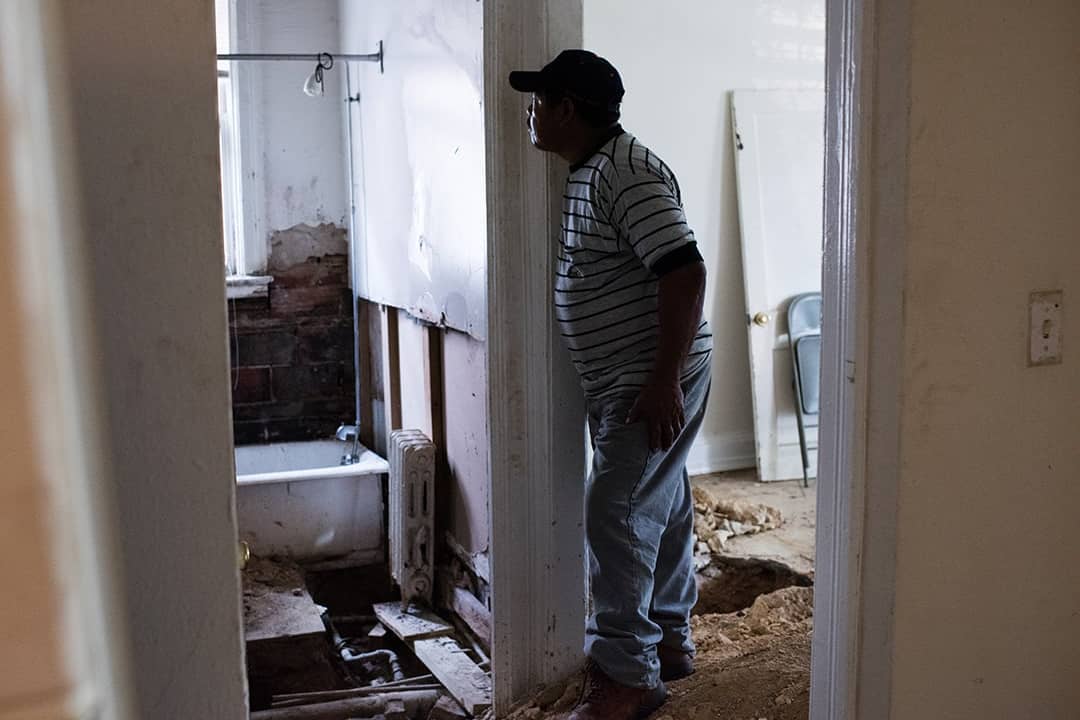
Sarah L. Voisin // The Washington Post via Getty Images
How to identify and report an exploitative landlord
Scroll through social media or turn on the news, and you’ll see a story about a landlord being charged for negligence. You might even know someone who calls their landlord a “slumlord,” whether jokingly or not.
The “slumlord” label isn’t an official legal accusation, but a landlord who has crossed into this territory may face code citations, lawsuits, fines, and even criminal charges.
Ultimately, renters need to know which red flags to watch for before signing a lease, and landlords must keep their properties in good shape.
To get you up to speed, TurboTenant dives into what makes a bad landlord, real-life cases of serious landlord neglect, and what tenants and property owners can do to prevent neglect from getting out of hand.
So, what is an exploitative or ‘bad’ landlord?
The exact conditions landlords must meet to keep a rental legally habitable vary by state. This obligation, commonly called the warranty of habitability, requires landlords to maintain basic health and safety standards, like working heat, plumbing, and electricity. Irresponsible landlords may also ignore serious problems that aren’t as clearly defined in state law, like invasive black mold.
Regardless of the finer points, though, it’s typically agreed upon that a “slumlord” is negligent to the point of endangering their tenants.
What’s the difference between a good landlord and a bad one?
A landlord who fails to complete a requested repair promptly doesn’t automatically fall into bad landlord territory (though the landlord should still handle that repair as soon as possible). Instead, what separates the two is a pattern of problematic behavior.
Exploitative landlords often repeatedly ignore repair requests and rent out units that fail to meet habitability standards. Affected tenants can’t safely live in properties with major issues like broken heating, exposed wiring, or pest problems, and they also can’t get the landlord (or anyone else, for that matter) to fix them.
Other red flags include self-help evictions, refusal to return security deposits, or retaliation against tenants who report problems. Though these are separate from the habitability issues that characterize a negligent landlord, these types of unsavory behavior often go hand in hand.
Before signing a new lease, renters should check their city’s code-violation portal for the address they’re considering. A quick Google search can often show whether a landlord and/or a building has past or existing citations for problems like broken plumbing, mold, or collapsed floors.
4 Landlord Cases to Know About
While some landlords may think they can get away with providing poor housing conditions, they often face major legal consequences, including orders to pay thousands (or millions) of dollars in damages. Some even end up in jail.
Here are a few egregious cases that both landlords and tenants should know about.
A Columbus Judge Handed a Landlord 175 Days in Jail
Joseph Alaura owned 32 rental properties around Columbus, Ohio. In 2024, the city filed a case against Alaura, citing violations at 17 of those properties, including a property without gas, electricity, or heat, and another with a rat infestation. Alaura was also already on probation after repeatedly ignoring orders to repair a fire-damaged duplex.
In May 2024, a Franklin County Environmental Court judge revoked Alaura’s probation and ordered him to serve the remaining 175 days of his sentence.
A Washington, D.C., Landlord Was Ordered to Refund 5 Years of Rent
Adolphe Edwards, a landlord in Washington, D.C., owned nine apartment buildings, comprising over 120 units in Wards 4 and 8. But when inspectors went through the properties, they found a litany of problems: sewage leaks, mold, pests, fire hazards, and ceilings on the verge of collapse. In all, the city identified more than 1,400 housing code violations for the portfolio under Edwards’ control.
In an April 2025 ruling, a court handed down a judgment against Edwards, requiring him to make good on the rent of some 100 tenants for the period from January 2018 to April 2023. The rent refunds came to $1.5 million, and $5 million in civil penalties pushed the judgment to $6.8 million.
Whether Edwards will ever repay his victims remains to be seen.
A Las Vegas Ceiling Collapsed After Years of Leak Complaints
A mother and her two children moved into the Las Palomas apartments in Las Vegas in August 2019. Their ceiling collapsed just a few months later, in November.
Anza Management, the company managing the property, had already fielded 11 complaints about ceiling and roof leaks and 25 more about water leaks and mold at that address over the previous five years. The company continued leasing the units.
A Nevada jury awarded the family more than $6.6 million in December 2024, finding the company liable for negligence, gross negligence, and breach of the implied warranty of habitability. Anza Management appealed the following month.
2 Minneapolis Landlords Lost Their Licenses on 60 Buildings
Minneapolis landlords Spiros Zorbalas and Stephen Frenz controlled more than 60 apartment buildings where tenants spent years reporting rats, bedbugs, broken heat, and failed plumbing. In 2011, after a years-long licensing fight, the city revoked Zorbalas’s rental licenses and barred him from holding an interest in Minneapolis rental licenses for five years.
Stephen Frenz announced in 2013 that he had bought the portfolio from Zorbalas, but tenants kept reporting the same conditions. The city then revoked Frenz’s licenses on 60 properties after finding that Zorbalas still held a major financial interest.
Frenz also fought a tenant lawsuit with phony leases and a falsified affidavit, which drew a $187,390 sanction for bad-faith litigation conduct and later led to a 2019 perjury conviction. The two landlords also settled with as many as 5,400 tenants for $18.5 million in 2018.
How to Report an Exploitative Landlord
If the stories above make one thing clear, it’s that serious housing neglect can quickly put tenants in unsafe and costly situations. Here are a few steps to take if you’re a renter living in unsafe conditions.
First, report the issue through the correct channels. If the landlord repeatedly ignores necessary repairs, consult the federal tenant rights guide to find the state agency that handles tenant complaints. Residents in HUD-insured buildings should refer to the Multifamily Housing Complaint Line.
From there, compile as much detailed documentation as possible. Log every request in writing, take pictures of the problem(s), and record how long the landlord takes to respond.
Withholding rent may seem like the obvious next step, but it could cause even bigger problems. California, for one, lets a tenant repair and deduct up to one month’s rent, twice in 12 months, while other states treat nonpayment as grounds for eviction, regardless of the property’s condition. Before taking such a consequential step, review your local laws to see what options are available.
What Neglect Costs Tenants, Cities, and Property Owners
Tenants shoulder the worst costs of property neglect. They face serious health risks and could have their belongings ruined by a pest infestation or leaky pipe, leading to costly damages and the mental toll that goes along with watching their home fall into disrepair.
Neglected properties can also drag down surrounding home values, especially when they deteriorate to the point of becoming vacant or abandoned. Vacant properties drive down tax revenue and increase a neighborhood’s costs for emergency services. And a 2022 Baltimore study put the city’s yearly bill for maintaining, boarding, and demolishing vacant properties at $100 million.
Finally, there are the property owners themselves. Repeated neglect can lead to citations, fines, civil suits, and even criminal charges in severe cases. Beyond legal trouble, ignoring crucial maintenance can also tank the rental property’s value and create even bigger repair bills down the road.
How to Keep Property Neglect From Piling Up
While some cases involve intentional landlord neglect, habitability issues can also happen accidentally. Deferred maintenance can quickly pile up if a landlord is running low on money or time, or simply doesn’t know the right people to get the job done.
To top it off, hands-off property owners who use property management companies may not realize their rentals have fallen into disrepair.
Fortunately, landlords can stay on top of their responsibilities with a few simple habits. Here’s what they should keep in mind:
- Handle emergencies immediately, especially failing heat, gas leaks, and other urgent issues.
- Communicate with tenants to confirm that they’re addressing the problem.
- Set aside funds in a maintenance reserve to cover major repairs.
- Log every maintenance request with a date to create an easily referenced paper trail.
- Keep a list of contractors on-call to handle emergencies.
- Inspect rentals at least once a year to look for major issues like rot or slow leaks.
- Know what state law requires regarding landlord disclosures and repair timelines.
Landlords who take these steps can avoid the notorious “slumlord” title.
Be a Good Landlord
Of course, no landlord wants to be known as exploitative. But without a dedicated maintenance workflow, repair request tracking, and healthy communication with tenants, property owners may let rental property conditions slip out of their control and fall far short of habitability requirements.
Those health and safety requirements aren’t just suggestions, either. State law gives a tenant the right to safe, habitable housing, and even the most dialed-in state-specific lease agreement cannot take that right away. And those who fail to meet that standard could end up in serious legal trouble.
To avoid crossing the line, landlords should start by getting a clear read on what they owe a tenant, create an audit-ready maintenance system that timestamps every request, and get into the habit of following up on every repair before the tenant has to ask twice.
This story was produced by TurboTenant and reviewed and distributed by Stacker.

